Screen time before bed: how much does blue light really matter?
Blue light suppressing melatonin is real physiology, but experts haven't reached consensus on how much it matters, and blocking glasses haven't shown a benefit in trials.
Screen time before bed: how much does blue light really matter?
“Blue light is ruining your sleep” has become one of the most repeated pieces of sleep advice around, spawning a whole industry of amber glasses and night-mode settings. The underlying science is real, but a closer look at the actual research suggests the story is more complicated than the marketing, and that what you’re doing on the screen may matter as much as the light coming out of it.
The mechanism is real: this part isn’t disputed
The basic biology behind the blue-light concern is well established. Light, particularly the shorter blue wavelengths that screens emit heavily, suppresses the release of melatonin, the hormone that helps signal to your body that it’s time to sleep, and can delay your circadian clock. A landmark 2014 Harvard Medical School study, published in the Proceedings of the National Academy of Sciences, had participants read either on a backlit e-reader or a printed book for four hours before bed across multiple nights. The e-reader group took longer to fall asleep, had reduced evening sleepiness, delayed melatonin release by roughly 1.5 hours, spent less time in REM sleep, and reported lower alertness the next morning compared with the printed-book condition.
That’s a real, well-documented effect, but it’s worth noting the study used four continuous hours of close-range reading, considerably more intensive exposure than a typical bedtime scroll.
Where the evidence gets murkier: real-world effects and glasses
Translating that lab finding into “screens definitely ruin everyone’s sleep” is where things get less clear-cut. A comprehensive 2024 consensus statement from the (US) National Sleep Foundation, reviewing the accumulated evidence on screen use and sleep health across the lifespan, explicitly stated that experts could not reach consensus on whether the light emitted by screens before sleep impairs sleep health in adults specifically. Some studies show clear effects, others find inconsistent or insufficient evidence, and adults may simply be more resilient to these effects than the popular narrative suggests.
The same review noted that interventions specifically designed to filter blue light consistently showed only minimal improvements in sleep health across the studies examined. That’s echoed by a 2025 systematic review and meta-analysis focused specifically on blue-light-blocking glasses, which found non-significant effects on both sleep onset latency (how long it takes to fall asleep) and total sleep time compared with clear lenses, based on the double-blind randomised trials available, though the review notes the total evidence base remains small (three trials, 49 people), so this shouldn’t be read as definitively ruling out any benefit either.
The piece that gets less attention: content, not just wavelength
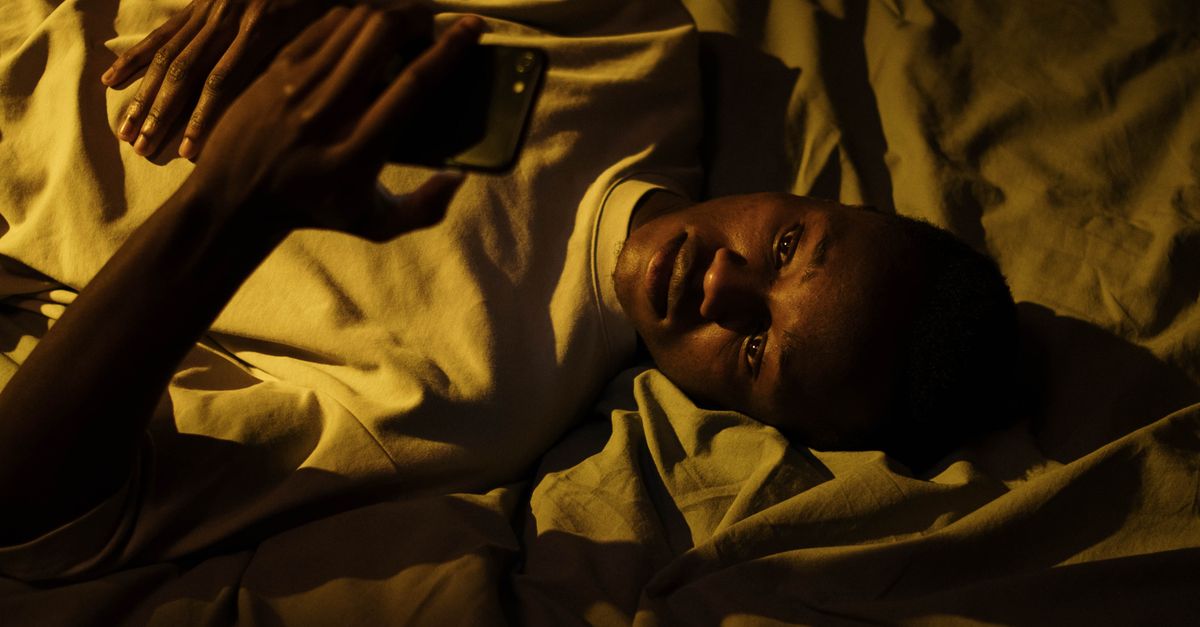
A growing strand of research suggests that what you’re actually doing on the screen, not just the light it emits, may be doing a meaningful share of the damage. One study specifically examining Facebook use found that light and socially-induced alertness interacted, suggesting emotionally or socially engaging content adds an arousal effect on top of, and somewhat separate from, the light exposure itself. Other research distinguishes passive screen use (watching a calm, familiar show) from more stimulating use (fast-paced content, exciting games, emotionally charged messaging), generally finding the latter more disruptive to sleep onset and quality, a pattern that points to mental arousal, not photons, as a meaningful independent driver.
This matters practically: a night-mode filter that shifts your screen to warmer colours addresses the light-wavelength half of the problem, but does nothing about the alertness generated by an argument in a group chat or a genuinely gripping show, which may explain why screen-time sleep advice that focuses purely on blue light sometimes doesn’t fully solve the problem for people who try it.
So what should you actually do?
Given the genuinely mixed evidence, a reasonable, non-alarmist approach looks like this: reducing screen brightness and switching to warmer, dimmer light in the evening is a low-cost step with plausible (if modest) benefit and essentially no downside. Being more deliberate about content, steering away from emotionally charged, argument-inducing or highly stimulating material in the hour before bed, addresses a mechanism the pure blue-light framing misses entirely. And if screens are realistically unavoidable in your evening (many people’s are), the evidence doesn’t support treating this as a moral failing or catastrophic sleep-wrecker, since the effect size in real-world adult use appears considerably smaller and less consistent than the more alarming version of this advice implies.
The honest takeaway
Blue light suppressing melatonin is genuine, well-established physiology, but the leap from “this happens in a controlled lab with four hours of close-range exposure” to “your ordinary evening phone use is definitely wrecking your sleep” isn’t as solid as it’s often presented. Expert consensus hasn’t been reached on real-world impact in adults, and blue-light-blocking glasses specifically haven’t shown a significant benefit in the trials so far. What you’re actually engaging with on the screen may matter at least as much as the wavelength it’s emitting.
FAQs
Does blue light from phones and screens actually affect sleep?
The underlying mechanism is real. Blue light suppresses melatonin and has been shown to delay sleep onset and reduce REM sleep in controlled studies. However, a major 2024 expert consensus review found no agreement on how much this matters for typical adult screen use in real-world conditions.
Do blue-light-blocking glasses actually work?
The evidence is weak so far. A 2025 meta-analysis of the available randomised trials found no significant effect on sleep onset time or total sleep duration, though the total number of trials is still small.
Does it matter what I’m doing on my phone before bed, not just the light?
Likely yes. Research suggests emotionally or socially engaging content (arguments, exciting shows, social media) may disrupt sleep through mental arousal, independent of the screen’s light output.
Should I stop using screens before bed entirely?
The evidence doesn’t clearly support that as a strict necessity for everyone. Dimming brightness, using warmer light settings, and choosing calmer content are lower-friction, evidence-consistent steps that don’t require eliminating screens altogether.
How much screen exposure is needed to actually delay melatonin, based on the research?
The most-cited study used four continuous hours of close-range reading on a backlit device, considerably more intense exposure than a brief bedtime scroll, so results from that specific study may not scale down proportionally to typical shorter use.
Is night mode / warm-light settings on my phone worth using?
It’s a reasonable, low-cost step that addresses the light-wavelength side of the equation, though it won’t address the separate mental-arousal effect of stimulating content, so it’s not a complete fix on its own.
Sources
- Chang et al. (2014): Evening use of light-emitting eReaders negatively affects sleep, PNAS / Harvard Medical School
- National Sleep Foundation (2024): The impact of screen use on sleep health across the lifespan: consensus statement, Sleep Health
- Luna-Rangel et al. (2025): Efficacy of blue-light blocking glasses on actigraphic sleep outcomes: meta-analysis, Frontiers in Neurology