Home workouts with no equipment: what actually builds strength
Bodyweight training can build real muscle and strength, as long as you push your sets close to failure and keep making the exercises harder. Here is what the research shows.
Home workouts with no equipment: what actually builds strength
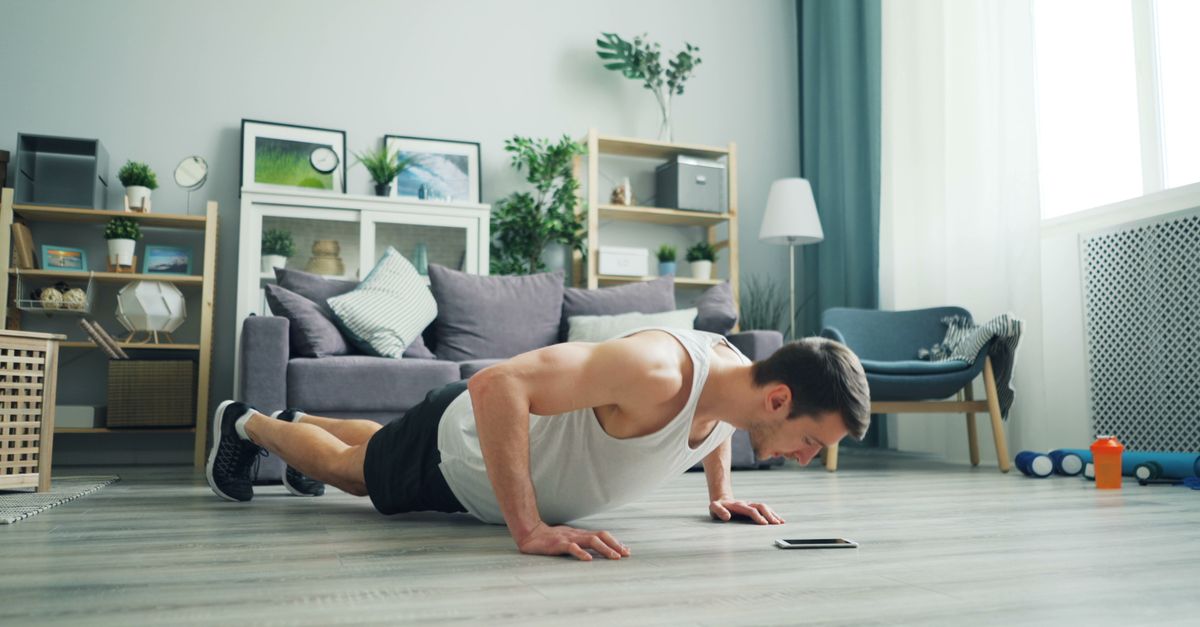
In an eight-week trial, young men who did push-ups twice a week gained about as much chest and triceps muscle, and as much bench press strength, as a group doing a matched bench press with a barbell. That is a small study, but it fits a wider body of research: your muscles do not know whether the resistance comes from a weight stack or your own body. They respond to effort.
That matters in November, when the evenings are dark and the gym feels a long way away. The honest answer is that home workouts with no equipment can build real strength, as long as you train in a way that keeps challenging your muscles. Most people fall short on that second part, not the first.
Why strength matters (and how much you need)
Strength training is not just for people chasing bigger arms. NHS guidance for adults aged 19 to 64 recommends strengthening activities that work the legs, hips, back, abdomen, chest, shoulders and arms on at least two days a week, on top of 150 minutes of moderate aerobic activity. The NHS examples include carrying heavy shopping, heavy gardening, yoga and bodyweight exercises such as push-ups and sit-ups. In other words, equipment is optional.
The headline evidence for why it is worth doing comes from a 2022 meta-analysis in the British Journal of Sports Medicine. Pooling 16 cohort studies, Momma and colleagues found that muscle-strengthening activity was associated with a 10-17% lower risk of death from any cause, cardiovascular disease, total cancer and diabetes. The biggest benefit appeared at around 30 to 60 minutes a week. That is two or three short sessions.
Can bodyweight training really build strength?
Yes, with one important condition: the effort has to be high enough. Muscles grow and get stronger when they are made to work hard, and research over the past decade suggests that “hard” can be reached with lighter loads, as long as you do enough repetitions.
A 2017 meta-analysis by Schoenfeld and colleagues pooled 21 studies comparing low loads (60% of your one-rep maximum or less, often 20 to 30 reps per set) with heavy loads. When every set was taken to muscular failure, muscle growth was broadly similar between the two. Heavy loads did produce bigger gains in maximal strength, which makes sense: lifting near your limit is a skill as well as a muscle job, and you get better at what you practise.
The catch: you need to keep it hard
This is where most no-equipment workouts fall down. Twenty bodyweight squats might be hard in week one, but by week four they are a warm-up. If you keep doing the same thing, your body has no reason to keep adapting.
A 2024 series of meta-regressions led by Robinson and colleagues in Sports Medicine looked at how close to failure people need to train. For muscle growth, gains tended to increase as sets were taken closer to failure. For strength, the relationship was much weaker. The authors described their analysis as exploratory, but the practical message is fairly clear: if you are using light resistance, such as your own bodyweight, finishing sets with only a couple of reps left in the tank matters more than it would with heavy weights.
You do not need to grind every set to collapse. A sensible target is to stop when you think you could only manage one to three more good reps.
How to make bodyweight exercises harder
Without dumbbells, you progress by changing the exercise, not the weight. Ways to do that:
- Change the angle or leverage. Move from wall press-ups to kitchen-worktop press-ups to knee press-ups to full push-ups, then to feet-raised push-ups.
- Go single-limb. Split squats, then rear-foot-elevated split squats with your back foot on the sofa, put far more of your bodyweight through one leg than a normal squat. Single-leg glute bridges do the same for your hips.
- Slow it down. Taking three or four seconds to lower into each rep keeps the muscle under tension for longer and makes a familiar exercise much tougher.
- Add pauses. A two-second hold at the bottom of a squat or push-up removes the bounce that makes reps easier.
- Do more reps or sets. Track your numbers and aim to beat them slowly week to week.
- Use household objects carefully. A rucksack with books, or full water bottles, can add load to squats and lunges. Keep it secure and stable.
A simple full-body session might be push-ups, split squats, glute bridges, a back exercise such as “superman” holds or towel rows on a sturdy door frame, and a plank. Two or three sets of each, twice a week, fits squarely within NHS guidance.
Is it enough for older adults?
For older adults, maintaining leg strength is about independence, not aesthetics. The NHS publishes a set of simple home strength exercises, including sit-to-stands from a chair, mini-squats holding a chair back, calf raises and wall press-ups, and suggests doing them at least twice a week and building up gradually.
There is research to support this approach. In a small 2021 study in Scientific Reports, Yoshiko and Watanabe had 16 adults aged 65 and over do home squats to a chair, using furniture to set the depth, three days a week for 12 weeks. Both shallow and deep squat groups improved their sit-to-stand performance and leg press strength. Muscle thickness did not change much, and the study was tiny, but it shows that simple, equipment-free training at home can improve the physical function that matters day to day.
Final thoughts
You do not need a gym to get stronger. The research suggests that bodyweight training can build muscle and strength, provided you push your sets reasonably close to failure and keep making the exercises harder over time. Heavy weights still have the edge for maximal strength, and pulling exercises are tricky without some kit, but for most people a consistent home routine twice a week covers the NHS recommendation and then some. This is general information, not medical advice. If you have a health condition, an injury or symptoms such as chest pain, dizziness or breathlessness when you exercise, stop and speak to your GP, or call NHS 111 if you are unsure.
FAQs
Can you build muscle without weights?
Yes. Research comparing light and heavy loads suggests muscle growth is broadly similar when sets are taken close to failure, and small trials show push-ups can match the bench press for muscle gain when the effort is matched.
How many times a week should I do bodyweight strength training?
The NHS recommends strengthening activities on at least two days a week, working all the major muscle groups. Two or three full-body sessions is a sensible target for most people.
Are push-ups as good as bench press?
For building muscle and general strength, they can be, if the difficulty is matched. Small trials found similar gains over eight weeks. If your goal is a heavier one-rep bench press, practising the lift itself still helps.
How many reps should I do?
There is no magic number. With bodyweight exercises, sets of anywhere from about 8 to 30 can work, as long as you finish each set feeling you could only manage one to three more good reps.
Do I need to train to failure?
Not every set. Research suggests getting close to failure matters more for muscle growth than for strength, especially with lighter loads. Stopping one to three reps short is a reasonable, safer target.
What if bodyweight exercises get too easy?
Make them harder rather than just doing endless reps. Try single-leg versions, slower lowering, pauses at the bottom, raised-feet push-ups or adding a loaded rucksack.
How do I train my back without equipment?
It is the hardest area to train without kit. Prone “superman” holds help, and a resistance band or a secure door-frame row can add pulling work. Only use set-ups that cannot slip or give way.
Is bodyweight training safe for older adults?
Generally yes, and it can be very worthwhile. The NHS has chair-based home strength exercises designed for older people. Start gently, use a sturdy chair without wheels, and speak to your GP first if you have a health condition.
How long until I see results?
Many people find they can do more reps within a few weeks, partly because they simply get better at the movement. The trials above ran for eight to twelve weeks, and visible changes vary a lot from person to person.
Sources
- NHS: Physical activity guidelines for adults aged 19 to 64
- NHS: Strength exercises
- Momma et al.: Muscle-strengthening activities are associated with lower risk and mortality in major non-communicable diseases, BJSM (2022)
- Schoenfeld et al.: Strength and hypertrophy adaptations between low- vs. high-load resistance training, JSCR (2017)
- Summary of Schoenfeld et al. (2017), Canadian Kinesiology Alliance
- Calatayud et al.: Bench press and push-up at comparable levels of muscle activity results in similar strength gains, JSCR (2015)
- Kikuchi & Nakazato: Low-load bench press and push-up induce similar muscle hypertrophy and strength gain, J Exerc Sci Fit (2017)
- Robinson et al.: Exploring the dose-response relationship between estimated resistance training proximity to failure, strength gain, and muscle hypertrophy, Sports Medicine (2024)
- Yoshiko & Watanabe: Impact of home-based squat training with two-depths in older adults, Scientific Reports (2021)