Breathwork: does slow breathing actually calm you down?
Slow breathing has a reasonable physiological basis and modest evidence for easing stress. Here is what the trials show and how to try it safely.
Breathwork: does slow breathing actually calm you down?
In a Stanford study published in 2023, people who spent five minutes a day on a breathing exercise with long, slow exhales reported a bigger lift in mood over a month than people who spent the same time on mindfulness meditation. Their breathing rate at rest also fell further.
Breathwork has gone from yoga studios to apps, workplace wellbeing sessions and the end of every second podcast. Some of the claims are modest and plausible; others are wildly overcooked. Here is what the research supports about slow breathing and stress, where the evidence runs out, and how to try it without any special equipment.
What breathwork actually is
Breathwork is a broad label for any practice where you deliberately control how you breathe. That covers a lot of ground. At one end are slow, gentle techniques, such as breathing at around six breaths a minute or making your out-breath longer than your in-breath. At the other are fast, intense methods involving rapid breathing and long breath-holds.
These are not interchangeable. Slow breathing is generally aimed at calming the body down. Fast breathing styles tend to do the opposite in the short term, and they come with different safety considerations. Most of the research on stress and calm is about the slow end of the spectrum, so that is the focus here.
Why slow breathing might calm you down
Your heart rate naturally rises a little when you breathe in and falls when you breathe out. This rhythm, called respiratory sinus arrhythmia, is one part of heart rate variability, which is often used as a rough marker of how active the parasympathetic or “rest and digest” side of your nervous system is.
Slowing your breathing to around six breaths a minute tends to exaggerate this rhythm. A 2018 systematic review by Zaccaro and colleagues, covering 15 studies of slow breathing in healthy adults, found it generally increased heart rate variability and was linked to some changes in brain activity associated with relaxed alertness. Several of the included studies also reported less anxiety and better mood, though others found no change.
A much larger 2022 meta-analysis by Laborde and colleagues, including more than 200 studies, found voluntary slow breathing increased the type of heart rate variability linked to the vagus nerve, both during a session, immediately afterwards and after a series of sessions. That is a reasonably solid physiological finding. Whether it reliably translates into feeling less stressed day to day is a separate question.
The Stanford cyclic sighing study
The study mentioned at the top, by Balban and colleagues in Cell Reports Medicine, randomly assigned 108 healthy adults to one of four five-minute daily practices for 28 days: cyclic sighing, box breathing, a fast breathing technique with breath-holds, or mindfulness meditation.
All four groups reported better mood and less anxiety after their sessions. Cyclic sighing, which involves two inhales through the nose followed by a long, slow exhale through the mouth, produced the biggest increase in positive mood, and the benefit grew over the month. It also lowered resting breathing rate more than mindfulness did, and the bigger the drop in breathing rate, the bigger the boost in mood.
It is a neat result, but there are caveats worth knowing. Most participants were young Stanford students, the study ran remotely so nobody checked that people were doing the exercises correctly, and it lasted only a month. There were no significant changes in heart rate variability, sleep or longer-term anxiety in any group. It is a promising small trial, not a definitive answer.
How to try slow breathing
You do not need an app, a course or a special mat. Three simple options, all of which have been used in research or public health advice:
- The NHS method. Sit or lie comfortably with your feet flat on the floor if sitting. Breathe in gently through your nose, letting your belly rise, counting from one to five. Breathe out gently through your mouth, counting from one to five. Do not force it, and do not worry if you cannot reach five at first. Repeat for at least five minutes
- Longer exhale. Breathe in for a count of about four and out for a count of about six. Many people find that lengthening the out-breath feels naturally calming
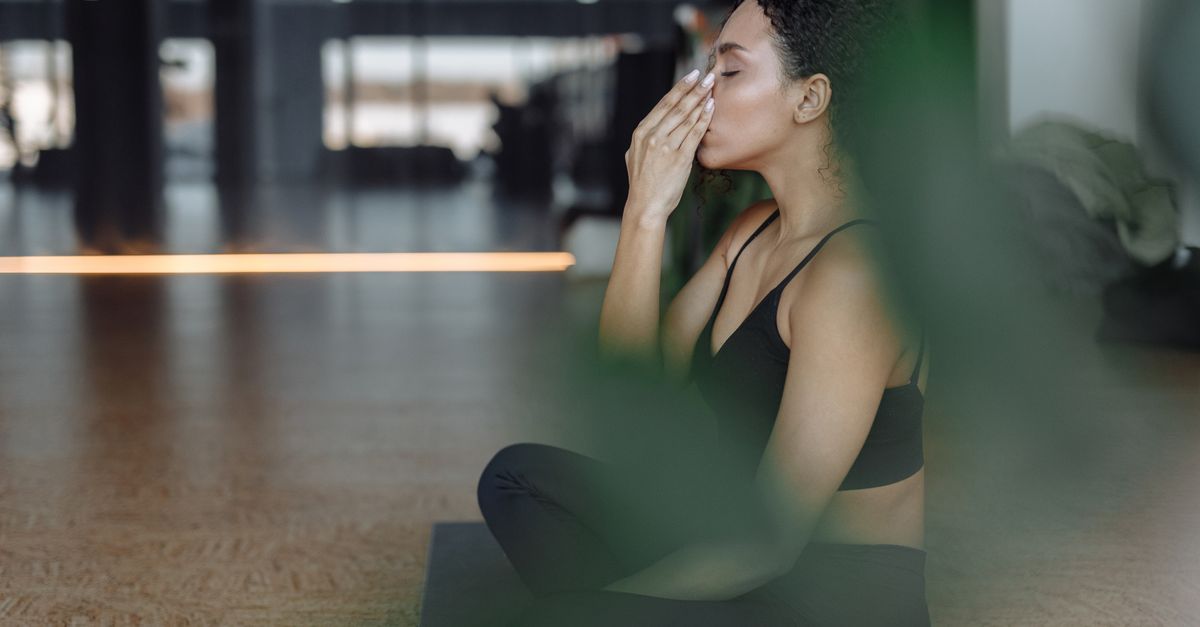
- Cyclic sighing. Take a breath in through your nose, then a second shorter top-up breath, then let it all out slowly through your mouth. Repeat for a few minutes
The NHS says you will get the most benefit by making breathing exercises part of your daily routine rather than saving them for emergencies. Five minutes before bed, on the train or between meetings is a realistic start.
What breathwork will not do
Breathing exercises are a useful tool for taking the edge off stress in the moment, and possibly for building a bit of resilience with regular practice. They are not a treatment for anxiety disorders, panic disorder or depression on their own, and they will not fix the circumstances causing your stress.
If anxiety is affecting your daily life, the NHS offers talking therapies, which you can usually refer yourself to without seeing a GP first. Breathing techniques are often taught as part of these therapies, but alongside other evidence-based approaches rather than instead of them.
It is also worth noting that some people find focusing on their breath makes them more anxious, not less, particularly if they have had panic attacks. If that is you, it is fine to try something else, such as a walk, a bath or talking to someone.
Final thoughts
Slow breathing has a reasonable physiological basis and modest but promising evidence for easing stress, and it costs nothing to try. Five minutes a day of gentle, slower breathing with a longer exhale is a sensible experiment, as long as you keep expectations realistic and steer clear of intense styles near water. This is general information, not medical advice. If stress or anxiety is getting in the way of everyday life, speak to your GP or refer yourself to NHS Talking Therapies, and if you are in crisis, call NHS 111 or Samaritans on 116 123.
FAQs
Does slow breathing really reduce stress?
It seems to help some people. A 2023 meta-analysis of randomised trials found small to medium improvements in stress, anxiety and depression, but most studies were small with a moderate risk of bias.
How slow is slow breathing?
Most research defines it as fewer than 10 breaths a minute, with many studies using about six breaths a minute, roughly a five-second in-breath and five-second out-breath.
What is cyclic sighing?
It is a breathing pattern with two inhales through the nose, the second a short top-up, followed by a long, slow exhale through the mouth. A small Stanford trial found it improved mood slightly more than mindfulness meditation.
What is box breathing?
Box breathing involves breathing in, holding, breathing out and holding again, each for an equal count, often four. It was one of the techniques tested in the Stanford study.
How long should I do breathing exercises for?
The NHS suggests at least five minutes, ideally as part of your daily routine. The Stanford study also used five minutes a day.
Is breathwork safe?
Slow, gentle breathing is generally safe. Fast breathing and breath-holding techniques can cause dizziness and fainting and should never be done in or near water or while driving.
Can breathing exercises help me sleep?
Some people find slow breathing helps them wind down, but the Stanford study found no significant effect on sleep over a month. It may be worth trying as part of a bedtime routine.
Is breathwork better than meditation?
In the Stanford study, cyclic sighing slightly outperformed mindfulness meditation for mood, but both helped. There is no strong evidence that one is clearly better for everyone.
Can breathing exercises treat anxiety?
They can be a helpful tool, but they are not a treatment for anxiety disorders on their own. NHS Talking Therapies offer evidence-based treatment and you can usually refer yourself.
Sources
- Fincham et al.: Effect of breathwork on stress and mental health, a meta-analysis of randomised-controlled trials, Scientific Reports (2023)
- PsyPost: Breathwork shows promise in reducing stress, anxiety and depression (coverage of Fincham et al.)
- Balban et al.: Brief structured respiration practices enhance mood and reduce physiological arousal, Cell Reports Medicine (2023)
- Zaccaro et al.: How breath-control can change your life, a systematic review on psycho-physiological correlates of slow breathing, Frontiers in Human Neuroscience (2018)
- Laborde et al.: Effects of voluntary slow breathing on heart rate and heart rate variability, Neuroscience and Biobehavioral Reviews (2022)
- NHS: Breathing exercises for stress
- NHS: NHS talking therapies for anxiety and depression
- ActiveSG Circle: Breath holding with hyperventilation, an invisible danger